
Partner content
When most people think of Florida, they think of beaches and theme parks. But if you're in the optics and photonics industry, Orlando is known for something much bigger.
The city is home to Central Florida Research Park (the sixth-largest research park in the US) and the Florida Photonics Cluster, a nonprofit organisation that connects industry, academia, and government to boost Florida's presence on the global stage. This concentration of research and industry has attracted major companies specialising in semiconductors, microelectronics, and photonics, including FARO Technologies, LightPath Technologies, Ocean Optics, and Northrop Grumman.
For students, this thriving ecosystem opens the door to many opportunities ( 23 regional jobs for every optics and photonics graduate ) that are hard to find elsewhere. And right in the middle of it all is the University of Central Florida's College of Optics & Photonics (CREOL) and its MS in Optics and Photonics programme.
Master the science of light with the University of Central Florida
#58
Best Global Universities for Optics (US News & World Report)
#9
Best Global Universities for Optics in the US (US News & World Report)
#4
Best US Public University for Optics (US News & World Report)
#1
Most Innovative University in Florida (US News & World Report)
IBM and Columbia University are partnering to make data centres more energy-efficient, as these facilities consume around 2% of U.S. energy supplies according to the Department of Energy. They are modelling AI's energy use, designing low-power chips, reducing software inefficiencies, and optimising system operations to address this issue.
V. Faye McNeill, professor of chemical engineering, is working with partners across the Global South to expand air quality monitoring in India, generate new air pollution data in Africa, and build local capacity in air quality science. The team’s success has led to informed policy decisions and improved air management across various regions.
The MS in Optics and Photonics is designed for students with a bachelor's degree in optics, electrical engineering, physics, mechanical engineering, or a related field. Combining rigorous academics with cutting-edge research, you'll benefit from:
Made for tomorrow's technology leaders
A high-quality education in optical science and engineering
Opportunities to engage in scholarly, fundamental, and applied research
A learning environment that contributes to the growth of technology-based industries in Florida and beyond
A campus designed for impact
Your fast track to an MS
Looking to earn your degree in a year? The accelerated schedule makes it possible. You can take four courses (12 credit hours) in the fall, another four in the spring, and two (six credit hours) in the summer.
As the timeline is fast-paced, students are encouraged to complete a three-credit-hour research report instead of a thesis. All other academic requirements remain the same as those for the standard MS and concentration options.
Study your way
With the MS in Optics and Photonics, you’ll have the flexibility to learn your way. You can study on campus at CREOL or earn the same degree from anywhere through Florida's only fully online MS in Optics and Photonics programme.
The curriculum is customisable to your interests too. You can choose from three concentrations — Photonics, Optics, or General Optics and Photonics — and complete the degree through a non-thesis, thesis, or research report option.
Regardless of the path you choose, all pathways require 30 graduate credit hours.
Learn from the world’s foremost experts
When you study at CREOL, you're learning from faculty who are pushing the boundaries of optics and photonics. Their research covers everything from basic science to prototype development, and they collaborate with leading companies, universities, and government laboratories around the world.
CREOL is just as connected with the wider UCF research ecosystem. Faculty work alongside experts from the NanoScience Technology Centre , the Burnett School of Biomedical Sciences , the Advanced Materials Processing and Analysis Centre (AMPAC), the Institute for Simulation and Training (IST), and the Florida Solar Energy Centre .
Many faculty hold joint appointments across these research units as well, which means you’ll have access to broader research opportunities and specialised facilities outside the traditional boundaries of optics and photonics.
Be part of the discovery
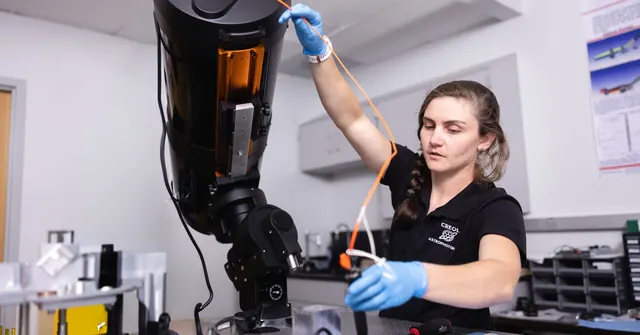
Every part of your master's studies takes place in a state-of-the-art, 96,000-square-foot facility built specifically for optics and photonics. It's an environment designed to encourage collaboration and hands-on learning.
Research is a key part of this experience too, and students are encouraged to get involved early. Those pursuing the thesis option may have the opportunity to work as research assistants, depending on funding availability and their advisor's support. In some cases, these positions also come with a tuition waiver.
View our programmes' catalogue
Optical Wave Propagation
Understanding how light interacts with different materials is fundamental to modern optics and photonics. In this course, students explore the principles of light propagation in free space and engineered materials, while learning how material interfaces shape optical behaviour. Topics include plane waves, Gaussian beams, Floquet modes, and the optical properties of isotropic, anisotropic, and periodic media.
OSE6111 Read more
Courses that power innovation
Nonlinear Optics
This course explores what happens when light becomes so intense that it no longer follows the usual rules of linear optics. Starting with Maxwell's equations, the course covers the fundamentals of nonlinear optics and how strong light fields interact with transparent materials.
The course also looks into how materials react to intense laser light, from the underlying physics (using both intuitive analogies and quantum theory) to real-world applications and materials used in modern optical labs.
OSE6334 Read more
Laser Engineering
Discover the science behind one of today's most important technologies. This introductory laser engineering course gives students the knowledge and skills to understand how lasers are designed, operate, and are applied across science and engineering.
Starting with the fundamental physics of laser operation, students explore resonator theory, continuous-wave and pulsed laser systems, and many common laser types. They also learn advanced techniques such as Q-switching, mode-locking, and harmonic generation, while gaining an introduction to the latest developments in laser technology.
OSE5525 Read more
Explore other courses
Explore other courses
Hear from the graduates
Luis Mateo Gonzalez
“I am from Paraguay, and I enroled in the MS in Optics and Photonics programme in Fall 2024 as a Fulbright Scholar. I attended the programme in person and completed the non-thesis MS degree in Fall 2025 with a perfect 4.0 GPA.
The professors were highly responsive and always willing to answer my questions. I especially found the ‘Fundamentals of Optoelectronic Devices’ course to be the most useful for me.”
Jia Xin Lim
“I am from Malaysia, and I enrolled in the MS in Optics and Photonics programme in Spring 2023 as a part-time student. I completed the online MS degree in Spring 2025.
Throughout the programme, the professors were readily available to help with any issues that arose.
While the courses were challenging, I found them to be manageable and very useful.”
Opportunity backed by care
The variety of opportunities at Leweston means every student has the chance to uncover new talents and passions. No matter where they begin, they’re backed by all-round support.
Where everyone belongs
International students are given a warm welcome with language support, cultural integration, and a structured settling-in programme. After that, the celebrations continue all year round, with Language Week, a Christmas Market, international evenings, and multicultural community events. Leweston’s Catholic values are at the heart of the school, shaping a culture built on community, responsibility, and dignity. Families from all faiths feel comfortable here.
A home away from home
t Leweston, the international student community is intentionally small. Boarders and day pupils mix naturally, rather than sticking to their own circles. It also means every student is truly known, with houseparents (many of whom were boarders themselves) on hand to help new students settle in quickly.
Opportunity backed by care
The variety of opportunities at Leweston means every student has the chance to uncover new talents and passions. No matter where they begin, they’re backed by all-round support.
A home away from home
At Leweston, the international student community is intentionally small. Boarders and day pupils mix naturally, rather than sticking to their own circles. It also means every student is truly known, with houseparents (many of whom were boarders themselves) on hand to help new students settle in quickly.
Where everyone belongs
International students are given a warm welcome with language support, cultural integration, and a structured settling-in programme. After that, the celebrations continue all year round, with Language Week, a Christmas Market, international evenings, and multicultural community events. Leweston’s Catholic values are at the heart of the school, shaping a culture built on community, responsibility, and dignity. Families from all faiths feel comfortable here.
Out with the old
SCI-Arc relocated several times — from Santa Monica to Marina del Rey, to Beethoven Street, and finally to downtown Los Angeles. Each move was both logistical and symbolic. “Moving to the Arts District was a big deal, and a bold move,” said Kevin McMahon, who’s worked at the school since 1987. “It was the right thing to do.”
The shifting geography of the school mirrored its belief in transformation. “This place is a chameleon,” said International Advisor Lisa Russo, who joined in 1986. “Just when you’re getting comfortable, you’ve got to get comfortable in a different way.”
This is why the architect, in SCI-Arc’s conception, is a connector: a synthesizer of form, systems, politics, science, and culture. Across physical installations, speculative fiction, urban reuse, and artificial intelligence, students’ thesis work reaffirms this.
“People come from all over the world to see thesis reviews at SCI-Arc. They want to see what the future of architecture holds. And the secret is — that’s why we come too.”
Erik Ghenoiu, History + Theory Coordinator
Join the next generation of optical innovators at the University of Central Florida.
Check out our sister MS Programme at UCF in Electrical Engineering - Electro-Optics Track